Wednesday, October 6, 2010

Cobblestoned Cove


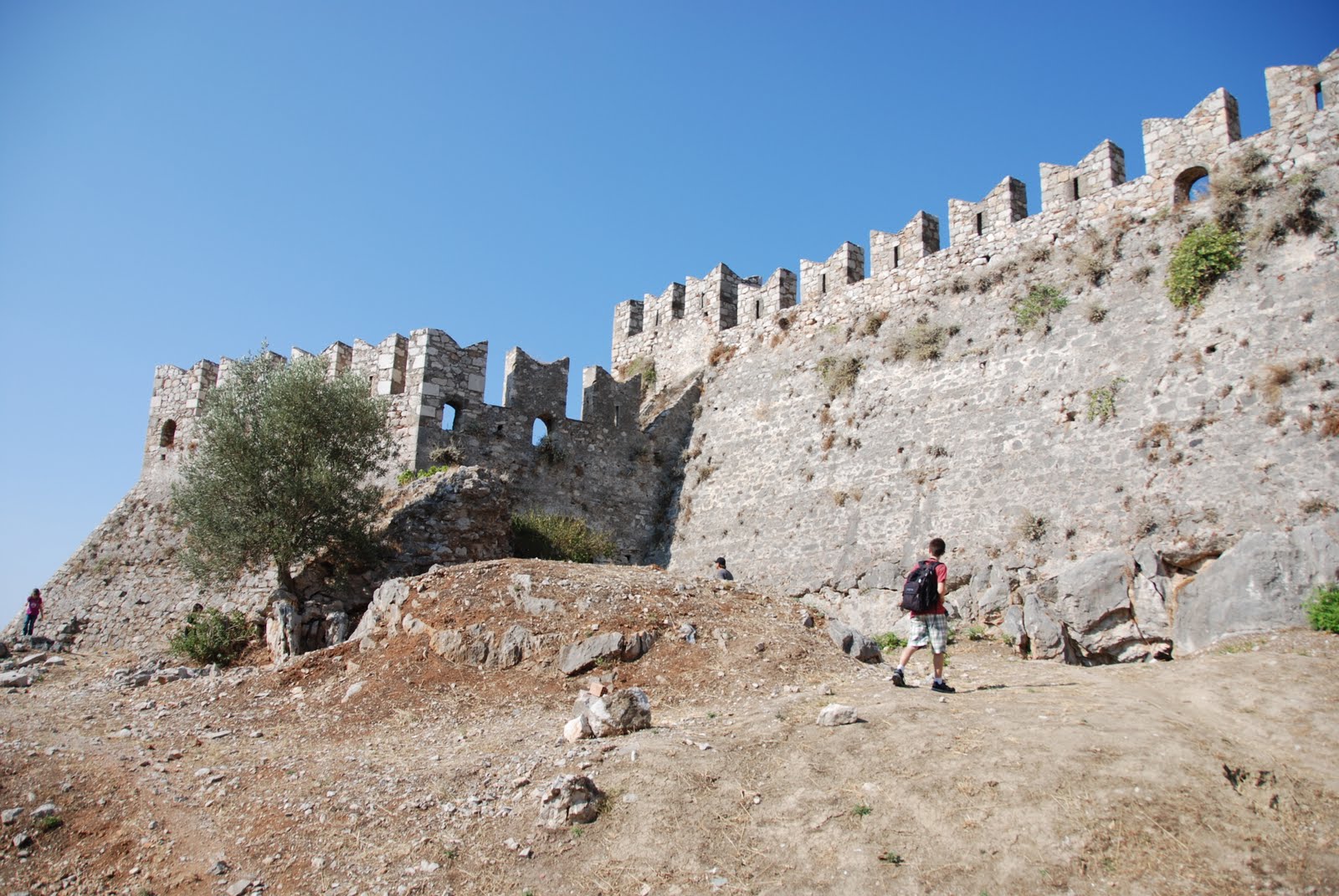
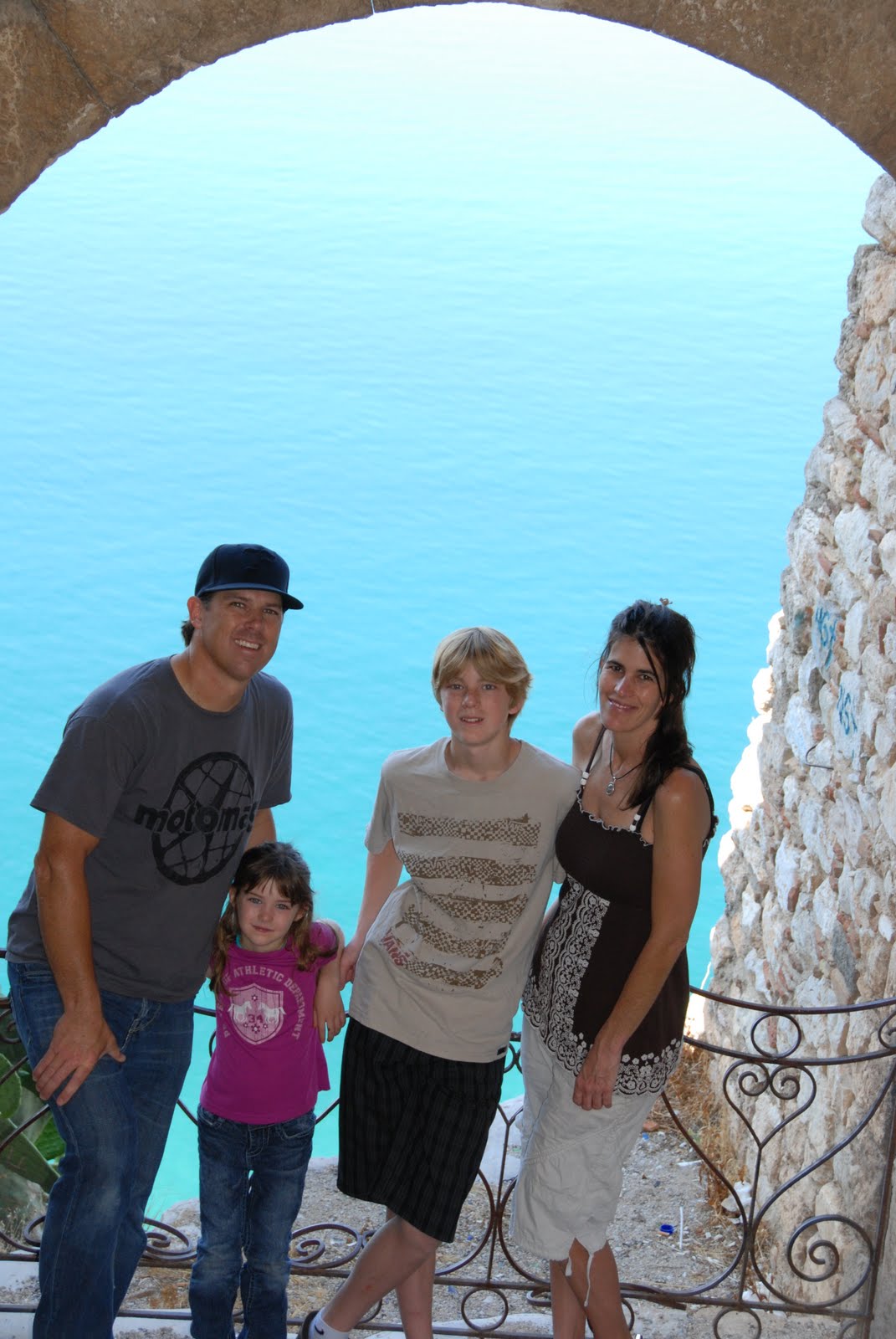
Lucky our guide decided to make a spontaneous stop. Naufplio--a gorgeous beachside town south of Mycenae in a natural peninsula in Peloponnese. We stroll through the harbor and into town. Beautiful cobblestone streets draped in bougainvillea. Hiking uphill on small steps, we aim for the clock tower of an old fortress that's become almost a skeletal foundation of the town. It's open--not crowded--another integration of the old and new. At the top, we are mesmerized by the aquamarine cove down below and wish more than anything to fly off the cliff, land in snorkel gear, and spend the next two weeks underwater. But alas, time ticks away. The view is full of patterns. Red tile roofs. Arches along the tips of the fortress. An old prison/island out in the bay. It's an incredible place. One hit hard by the economy. Shop owners rely on whatever they can sell. They make due if they can, but take each day with hope. Back in the square, we meet a cute Greek couple (actually, it's my dad in an adorable Greek cap and his wife.) They walk hand in hand through the romantic plaza. Love. Family. Paradise. All wrapped up into one.

Thank you Jeremy Woo-Sam for your lovely shots of Naufplio and our family!

Tuesday, October 5, 2010

Zeus Outside my Door


The drive from Corinth to Mycenea gives us an amazing glimpse into the country. Greece itself is on a point where three continents meet--creating a variety of flora. (Think olives and wine. Yum.) We pass glorious vineyards. White and pink oleander planted along the roads to ward off animals and prevent road kill. Small shrines (although some are really HUGE) are scattered roadside--iconostatse--18th century traditions built in memory of a lost lives. In the old days, the shrines held a bottle of red wine to honor the deceased. People would stop by to take a shot. (Humm...alcohol on the road? Who's idea?) I watch goats scuttle along the rocky cliffs, climb past orange trees as we get closer to the great center of power during the late Bronze Age: Mycenae.

It's a gorgeous mountain, naturally protected and crowned with the remains of ancient palaces and walls. We walk up the steep path to the entrance of the citadel--the Lion's Gate. Two lions stand as sentries of protection, leading into the palace. This legendary carving is the earliest known piece of European sculpture.

Just inside the Lion's Gate, we spot the grave circle--home of the iconic golden mask of Agamemnon. This site, once thought only a legend (founded by Perseus) in the poetry of Homer, was discovered by an amateur archeologist named Heinrich Schliemann in 1870. Mycenae was ruled by Agamemnon, the great Greek king who led troops against Troy. Upon returning victorious, he was murdered by his wife, Klytemenestra and her lover. Up toward the top of the site, we pass the remains of the bath where this crime took place. (Those Greeks are all about drama.) Despite it's dark past, it's a lovely walk around the mountain--views of green as far as the eye can see. An unusual feeling to be a present participant on an ancient stage.

We check out the Treasury of Atreus (Agamemnon's father--who they think the golden mask really belonged to.) The Tholos Tomb is empty--long ago pillaged, but it's sheer size (5.4 meters high) is breathtaking. It's muggy. Dark. It's emptiness creates such a void. Memories stolen. Outside, dark clouds rage. As we step through the threshold, thunder sends its voice across the sky. Have we angered the gods?

Who knows. It's true--we're observers of ancient myths come to life. Past cultures forever vanished. But somehow, the ancient feels not so far away. And it wouldn't surprise me in the least to find Zeus or Poseidon standing outside the door.

Greece. It's just like that.

Thursday, August 26, 2010

Layers Run Deep


Corinth. The Temple of Apollo. Greece has many temples dedicated to the god of the sun--like Delphi and Epidarus. But the temple here is the oldest in Greece and the only ancient Greek temple in Corinth. It's quiet. The sun warms my back as we venture through time.

A little history...Built earlier than most--around 560 BC, it had a tile roof, 38 Doric/limestone columns--of which 7 are still standing. This important location--the Isthmus of Corinth--a narrow strip separating Peloponnese and N. Greece thrived till the 8th century. Conquered by Phillip II in 338, who was then assassinated, Corinth soon came under the leadership of Alexander the Great--who led the Greeks against the Persians. It was partially destroyed by the Romans in 146 BC, and then rebuilt in 44 BC under Ceasar the Great--Roman Corinth emerged.

This magnificent epicenter held 800,000 citizens by the time Paul the Baptist arrived--who made two visits in the 50s AD. It was a place of business and pleasure, mainly populated by Jews and freedmen. In 67 AD, Nero wielded his golden shovel, and began constructing the Corinth Canal (but it was not finished until 1893! Talk about procrastination.) Corinth began its decline in the 300s AD, and then it was destroyed in 396 and all its inhabitants sold into slavery. When Constantinople fell , the geographic treasure of Corinth became a sought after prize. Captured by the Turks in 1458, the Knights of Malta in 1612, The Venetians in 1687-1715, back to the Turks, and then the Greek people finally laid claim to their lost city in 1822. It became the new center of commerce between N. & S. Greece--the main shipping route between the Ionian and Aegean Seas.

Now, walking through this ancient site, I'm once again struck by the layers. A sacred site: from prehistoric times, to Ancient Greek, Roman, and then Christian. Tied together by columns. Structures. Gardens. Fountains. Language. There is evidence here in Corinth that the Greek and Roman alphabet overlapped. A very unusual thing. (The Greek alphabet was adapted from the Phoenicians in 7th C BC.) What is it that connected these distinct cultures together? Was it merely stones constructed into meaning? Or an invisible spiritual bond emanating from the Earth? Centuries upon centuries of sacredness.

Most of the visible ruins are Roman--but much has been topple by Mother Nature. Statues of John the Baptist. A sacred spring and Peirene's Fountain--major sources of water for Corinth. Peirene has a beautiful story. She was a woman who wept so hard after losing her son, that she dissolved into the spring forever. There are possible temples to Aphrodite and Octavia--but the evidence not as obvious as the sun god's sanctuary here.

It's no surprise the air itself feels pure. Corinth is 85% mountains. Pine (its sap soon to be the STRONG, white wine called Retsina,) Cypress (known for connecting heaven and earth,) poplar, and eucalyptus. A castle far on the overlooking mountain. A fortress of protection. A point where 3 continents meet-- a variety of flora--olive and grapes. Wine. Vineyard. Homer said that "whoever doesn't know how to make wine is a barbarian." I can see that here. So beautiful. So green.

And then there are the dogs. The big-nosed, daschound/dobie (and who knows what else!) mix. She's just had babies (somewhere) and she is so so skinny. My heart breaks for her. I scratch behind her ears as she lays behind a rock in the heat. She moans. Out of joy or pain--I'm not sure. I fall in love with another dog too--a shepherd mix. He lays on my leg, melts into me as I rub his soft belly. I want to take him home.

Layers run deep. Longing. Sadness. Joy. Perseverance. It's all here, wrapped up in columns and mosaics and clear, sweet and beautiful air.


Friday, August 20, 2010

Long Live the Sea


Sounio, Greece


We drive south from Athens, along the serene Aegean Sea to the southernmost point of mainland Greece: Sounio. The gorgeous aquamarine horizon draws me in. Sunshine reflections make me drowsy--golden sprays across the water.


Poseidon's Temple. A grand temple to the god of the sea. The creater of islands. Calm seas. Earthquakes. The sanctuary stands atop sheer cliffs along the coast. A landmark for sailors. A site of striking beauty.

First mentioned in the Odyssey as Menelaus' first stop. The first temple was built around 500BC but never completed--but destroyed by the Persians in 480 BC. The current Temple of Poseidon (and a temple to Athena) was constructed on top these old ruins in forty years later. Fifteen of the original Doric marble columns stand today.

Again, I feel that peace walking around these ruins. Maybe it's the ocean breeze. The absolute quiet. The solitary olive tree that stands guard. I'm struck by the white columns contrasting so vibrantly against the sapphire sky. Their royal construction. Solid. Ground to sea and earth of times long gone by. What magic is it that makes them still stand today? I am thankful to science for unlocking ancient mysteries. Thankful for stories and myths that spurred the oldest of imaginations. Thankful for builders who constructed such beauty with heart, soul, and grace.

The power of Poseidon truly lies here. I can see it in the sparkle of gold on the water. Smell it in the purest of air. Sense it in my son's eyes.

Long live the sea. Long live Poseidon.

(thank you steve for your far away temple shot!)

Wednesday, August 18, 2010

Ancient Voices in Motion


One of my missions in Greece was to take my father back to Nemea, a village near Corinth where his parents were born. They passed away when he was a teen, and he'd never been to Greece. It was one of those important-must-do activities. So the day finally arrived...


We rent a car. Map out the route several times. Just about a two hour drive to Nemea--no problem. Ha! Let's just say it wasn't such a pleasant drive out of the city. Actually a hour-and-a-half-we-can't-find-our-way-out-of-Athens drive. Greek people are so nice. We stop. Ask directions. With my broken Greek and their broken English--we are told to go straight, turn left or right. But, they say, "ask someone else when you get there." AHHH! Where is "there?" It would have been nice if: a.) I spoke fluent Greek. b.) We read Greek (English translations on the map don't match up to Greek street names c.) We had a GPS. But alas, we didn't and we continue on--hearts pumping. I try to laugh. Make jokes of our predicament. Not a good idea. Just focus on the road. Get brother, son and father to Nemea.


Well, we do. Once out of the city, the drive is cake. Beautiful coastline. We cross the Corinth Canal from mainland Greece into Peloponnese. We wind through green, hilly country. First stop: Ancient Nemea, fomerly named Iraklion. Famous in Greek mythology and with Homer, this Nemea was the home of the Nemean Lion killed by Heracles. The Nemean Games were started by the famous "seven," (The Seven of Thebes,) to honor the infant Opheltes who was killed by a serpent while lying on a bed of parsley . The games began somewhere around 570 BC at Nemea's Temple of Zeus. Winners earned a crown of parsley, and the judges wore black in mourning.

Today, several temple columns have been re-erected. We climb all around the ruins--marveling at their stature and grace.We admire the column pieces on the ground. Massive, circular parts, once stacked together toward the sky. We visit the great alter and the ancient baths, pass skeletal remains of ancient Nemean citizens. I'm reminded of the heat on my skin. The chirp of the cicadas. We're alone at this ancient place. A place of mythology. A place of my origins. And it's magical.

Run near the stadium. Imagine the athletes bursting through the entrance tunnel. We hear voices. Ancient voices in motion. We move with them.

In the town of Nemea--it's quiet. Too quiet. Siesta time (3-5pm.) We're lucky to find a taverna open. We're starving so we gorge on Greek salad, potatoes, and enjoy a lovely Nemean red wine. Famous for its krasi (wine,) Homer called this place Ampelóessa, or "full of vines." We buy ice-cream bites from the sweet shop across the street. Other than the guy snoozing in front of his open air pet shop (really?) we don't see a single soul. We try to ask for a city hall to find records of my grandparents (Peter Polydoros or Mary Lazopolous) or any distant relative still here. But there is none. A cemetery maybe? We are told no. Much of Nemea was destroyed in WWII and we assume that these records disappeared along with it. We're down-trodden. Unable to grasp something concrete of our past. But we push forward. Visit a cemetery near Ancient Nemea. Beautiful tombstones--adorned with photos of the deceased. Lanterns. Flowers. (More on Greek cemeteries and burials later...)

On the way home, we stop at a Nemean winery. Rose and white. Light and fruity. We buy local pine honey as well. Yum. The drive back into Athens is just as fun as the way out. (Did I forget to mention that Greeks don't really follow any kind of driving rules? And motorcycles can appear magically just about anywhere on the road in a fraction of a second?) It takes us another hour just to get back into the city. We all get out at one point, ask different people directions and come up with the same answer. Our car rental office is just about 1/2 mile to our left. But... we can't turn around. So we take Syngrou Ave. for TEN miles down to the port before we can U-turn it. We're tired and cranky and completely delirious about driving in Athens. Wanting the hotel. Wanting dinner. Wanting some sanity.

It's easy to feel like a failure sometimes. Goals not reached. Inadequacies revealed.

But even though I can't find my way home. Even though we didn't find the birth records or gravestones of great-great-grandparents I realize then--surrounded by my dad, brother, my son--that we've created our own memories here in the place we began. We've made our own laughter. Our own footprints. And for that, I'm grateful.